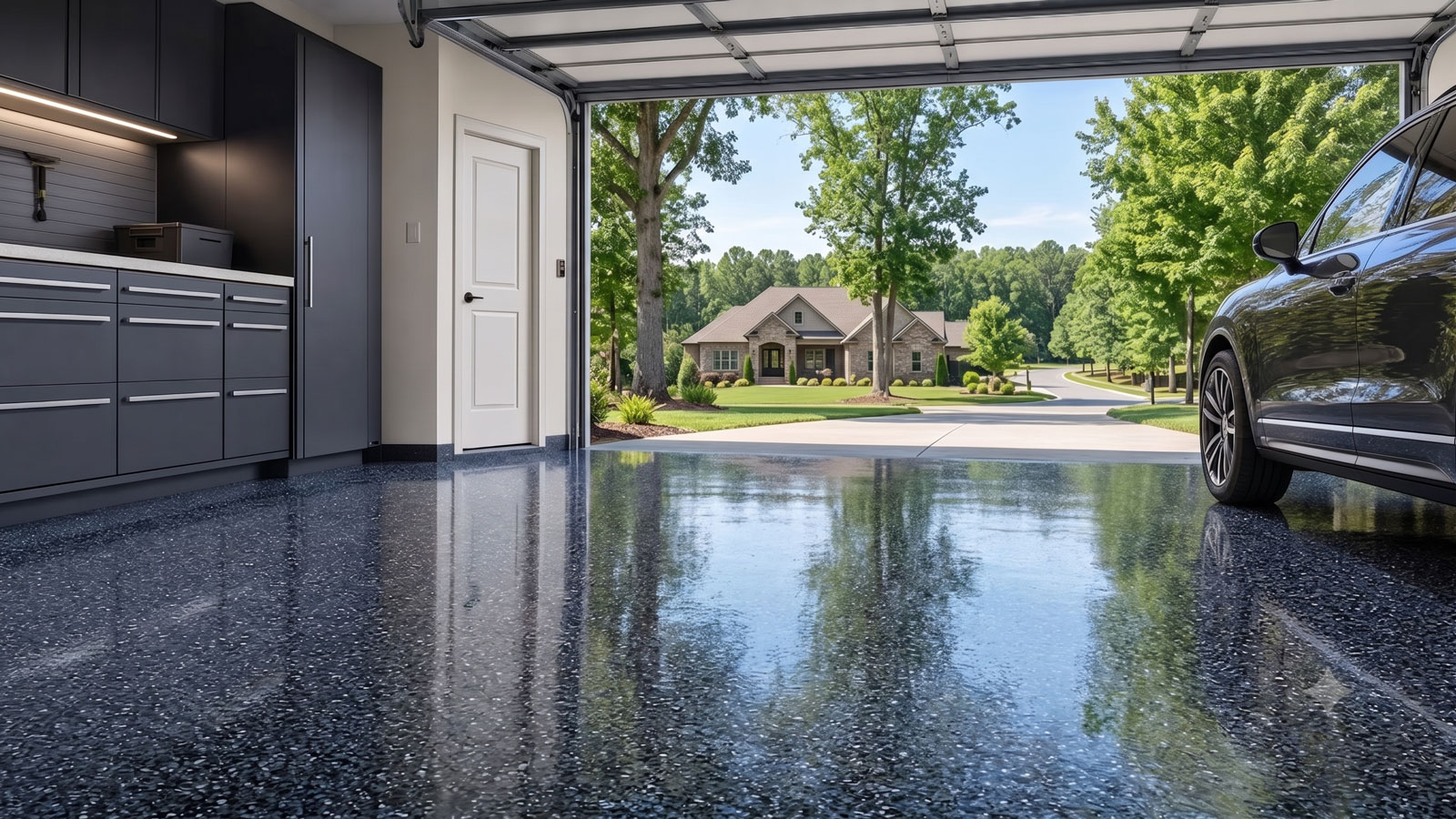
Garage Floor Coating in Mason, OH
Floor Coating Services in Mason, OH
Mason's residential growth includes many newer subdivisions with attached two- and three-car garages, family storage, sports gear, and daily vehicle traffic. The city also maps stormwater infrastructure, drainage basins, and flood zones, making property drainage a real site-specific consideration rather than an abstract one. Mason's rapid suburban growth means much of the garage stock is relatively young, but young concrete can still carry curing compounds, sealers, builder patches, and dense finishes that need mechanical profiling.
For a garage floor, that means checking driveway pitch, threshold water, slab joints, and curing history before installation. A newer garage can be structurally sound yet still need mechanical profiling and localized crack treatment. Newer development also relies on detention and stormwater systems, yet individual driveway grade and downspouts still matter at the garage threshold.
Mason households often need the garage back quickly, so cure schedule and storage staging can influence system choice as much as decorative color. That makes newer-looking concrete a preparation question, not a shortcut. That distinction is especially important in large family-entry garages.
Local Market Insight
Mason's newer subdivision pattern and mapped stormwater network make young-slab preparation, multi-bay layouts, and property-specific drainage the most useful local coating considerations.
What Affects the Cost of Garage Floor Coating in Mason?
Mason project scope often centers on builder-treatment removal, control joints, multi-bay layouts, subdivision drainage, storage, and cure timing. Older or altered floors can add previous coatings or repair history, so the actual slab should still be inspected rather than assumed simple because of neighborhood age.
- Three-car square footage: Larger suburban garages increase material, grinding time, and edge work. The quote should identify exactly what removal or repair is included before coating.
- Curing residue: Newer concrete can require careful profiling even when it looks clean. Check the actual property condition rather than inferring drainage from the neighborhood alone.
- Control joints: Young slabs commonly have planned joints that need an intentional finish strategy. Mechanical preparation should reach sound concrete rather than simply roughen the surface.
- Drainage at the threshold: Subdivision grading and driveway pitch can influence stormwater exposure. The repair plan should distinguish stable cracks from joints intended to move.
- Return-to-service timing: Busy households may prioritize systems with faster cure schedules. Match traction and cleanability to how the garage is actually used.
- Drainage-basin location: Mason's mapped stormwater inlets, outfalls, detention areas, drainage basins, and FEMA flood zones make property-specific water history worth checking before coating.
Call for a clear, project-specific estimate — or request one online.
Local Garage-Floor Conditions in Mason
Inspect the slab for smooth hard-troweled areas, construction residue, cracks, and any sealer or curing treatment. Those details matter more than the floor's visual cleanliness.
Use actual water history to judge drainage. FEMA mapping and stormwater infrastructure describe the area, but the garage door and driveway show what happens at the property.
If the garage holds sports gear, bikes, freezers, and household storage, decide how those items will be staged before installation begins.
Young Slabs and Multi-Bay Garages
A newer Mason garage often requires less repair than an older urban slab, but that does not eliminate preparation. Adhesion still depends on creating the correct concrete profile.
Three-car layouts also make finish consistency, cure timing, and storage logistics more noticeable because the project footprint is larger.
Mason's Public Mapping Makes Drainage Easier to Verify
Mason's public mapping includes stormwater inlets, outfalls, detention areas, drainage basins, watershed boundaries, and the FEMA 100-year flood zone. That does not mean every newer subdivision garage has a water issue; it gives homeowners a better way to separate ordinary snowmelt from a real site-drainage concern.
A floor-coating quote should still be based on what happens at the slab: driveway pitch, door-line ponding, damp edges, cracks, and whether the concrete has curing residue or a smooth finish that needs profiling.
A strong Mason estimate should make the invisible preparation visible. It should explain how curing products or sealers will be removed, how joints and builder repairs will be handled, and whether storage or multiple bays add edge work. Drainage should remain a separate property-level question so modern subdivision infrastructure is not mistaken for perfect garage grading.
Mason homeowners should also expect garage use to affect staging and finish priorities. Family-entry traffic, sports gear, storage systems, bicycles, and multiple vehicles can make return-to-service timing important. Those logistics should be planned after the slab's builder treatments, joints, and repairs are understood so convenience does not replace the preparation needed for adhesion.
Mason's newer housing stock also means homeowners may underestimate how much detail exists outside the center of the slab. Steps, stem walls, expansion edges, control joints, storage alcoves, and transitions at the garage door can all add grinding and masking. A strong quote should name those details explicitly rather than bury them inside a generic square-foot figure. That keeps builder-treatment removal and lot drainage as separate scope items.
Mason Garage Floor Coating FAQs
Can a new Mason garage be coated immediately?
The concrete must be sufficiently cured and acceptable for the chosen system. Even then, proper mechanical preparation is still needed. at the specific property. during the on-site evaluation.
Does Mason's flood-zone mapping mean my garage is at risk?
Not necessarily. Flood and drainage conditions are property-specific. Use mapping together with actual driveway and storm history. at the specific property. during the on-site evaluation.
Do control joints have to disappear?
No. Some joints remain visible by design; others may be treated depending on movement, aesthetics, and installer specifications. at the specific property. during the on-site evaluation.
Why might a three-car garage quote be more than a simple square-foot calculation?
Extra edges, steps, storage, repairs, and staging can add labor beyond raw floor area. at the specific property. during the on-site evaluation.
Should I check Mason's drainage or flood maps before coating?
It can be useful if the property has a water history. Mapping adds context, but actual signs at the driveway and slab remain the deciding evidence. at the specific property. during the on-site evaluation.
Mason Neighborhoods & Local Context
Phone Quote Line
Speak with a floor coating specialist about your project and get a realistic estimate range.
(513) 866-3188Typical Project Cost
$3,000–$5,500
Typical range for a two-car garage. Final pricing depends on floor size, concrete condition, prep work, coating type, and finish options.
Helpful Guides
Other Service Areas